 cbe2ab87c6
* Renaming some component classes in DataTable

* Some more renaming of DataTable component classes

* Separate styling for fixed rows/columns from labels

* Highlight fixed rows/cols affected by colour differently

* Tweaking styles for fixed data in DataTable

* Update DataTable snapshots

* Add row label to Row metadata

* Wiring up some labelled row logic behind flags

* Renaming variable in DataTable

* Variable renaming in DataTable

* [no ci] Labelling rows progress

* Add RenderedRow abstraction to DataTable

* Computing label widths

* Use the Column object to represent row label column

* Ability to toggle row labels reactively

* Adjust width calculation for label widths

* Add DataTable.RowLabelSelected

* Posting the RowLabelClick message

* Hovering of row labels applies new style

* Remove a print

* Ensure horizontal scrolling with column cursor accounts for row label column

* Account for possible row labels in cell cursor horizontal scrolling

* Ensure cursor highlighting is correct on row label cells

* Document component class for DataTable label hover

* Test to ensure clicking row label emits correct event

* Add snapshot test for DataTable with fixed rows/cols and row labels

* Using pilot pause instead of wait_for_idle directly

* Update CHANGELOG

* Add a docstring

* Add a note to CHANGELOG.md about RowLabelSelected
Textual
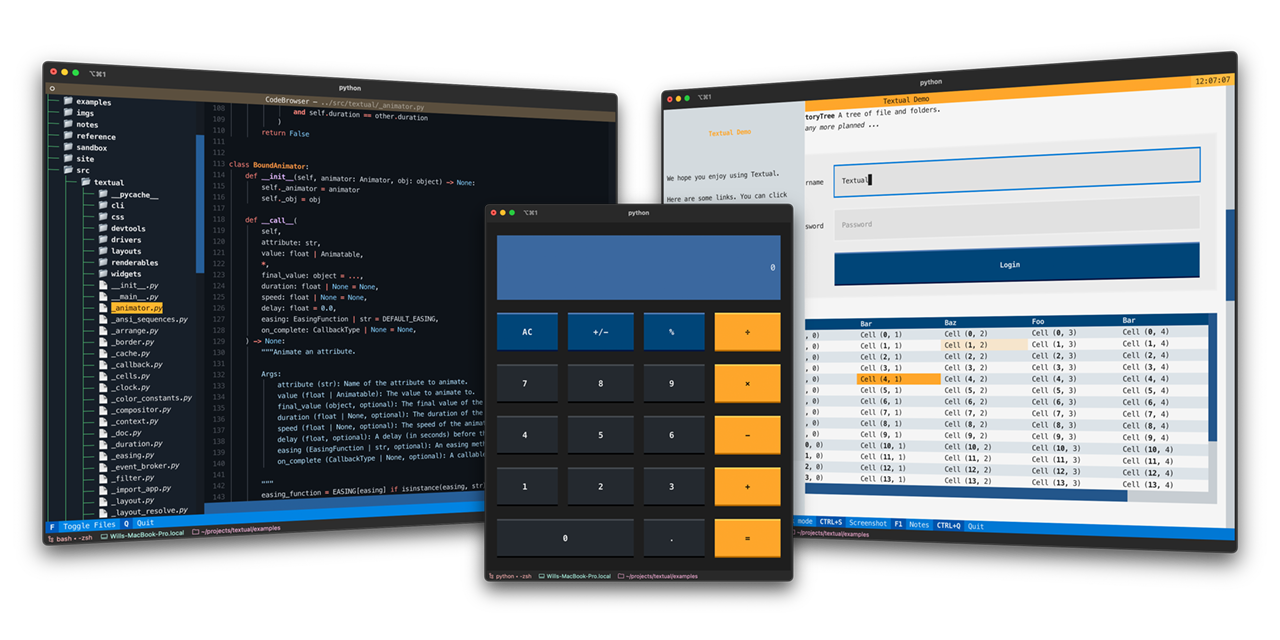
Textual is a Rapid Application Development framework for Python.
Build sophisticated user interfaces with a simple Python API. Run your apps in the terminal and (coming soon) a web browser!
🎬 Demonstration
A quick run through of some Textual features.
https://user-images.githubusercontent.com/554369/197355913-65d3c125-493d-4c05-a590-5311f16c40ff.mov
About
Textual adds interactivity to Rich with an API inspired by modern web development.
On modern terminal software (installed by default on most systems), Textual apps can use 16.7 million colors with mouse support and smooth flicker-free animation. A powerful layout engine and re-usable components makes it possible to build apps that rival the desktop and web experience.
Compatibility
Textual runs on Linux, macOS, and Windows. Textual requires Python 3.7 or above.
Installing
Install Textual via pip:
pip install "textual[dev]"
The addition of [dev] installs Textual development tools. See the docs if you need help getting started.
Demo
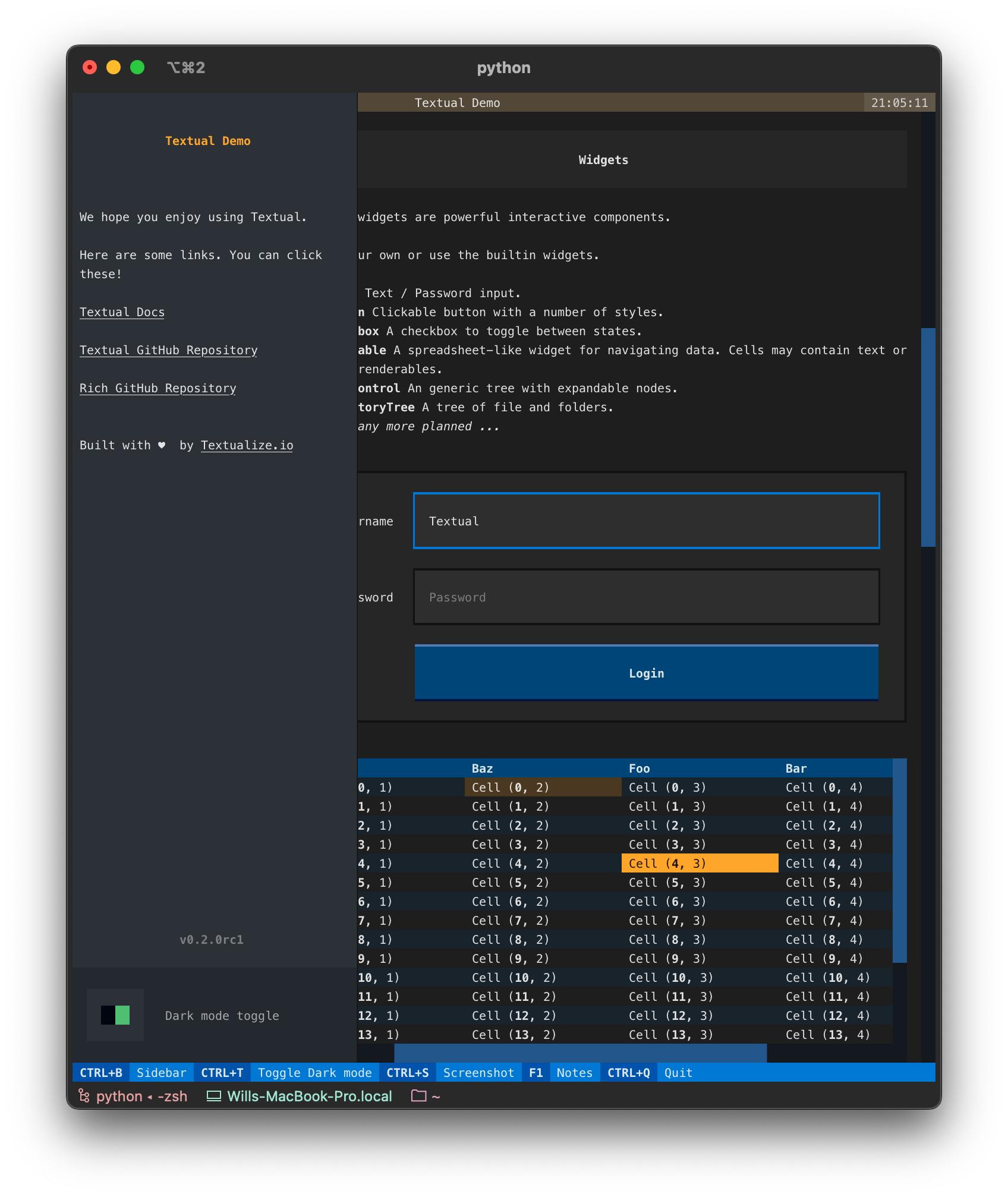
Run the following command to see a little of what Textual can do:
python -m textual
Documentation
Head over to the Textual documentation to start building!
Examples
The Textual repository comes with a number of examples you can experiment with or use as a template for your own projects.
🎬 Code browser
This is the code_browser.py example which clocks in at 61 lines (including docstrings and blank lines).
https://user-images.githubusercontent.com/554369/197188237-88d3f7e4-4e5f-40b5-b996-c47b19ee2f49.mov
🎬 Stopwatch
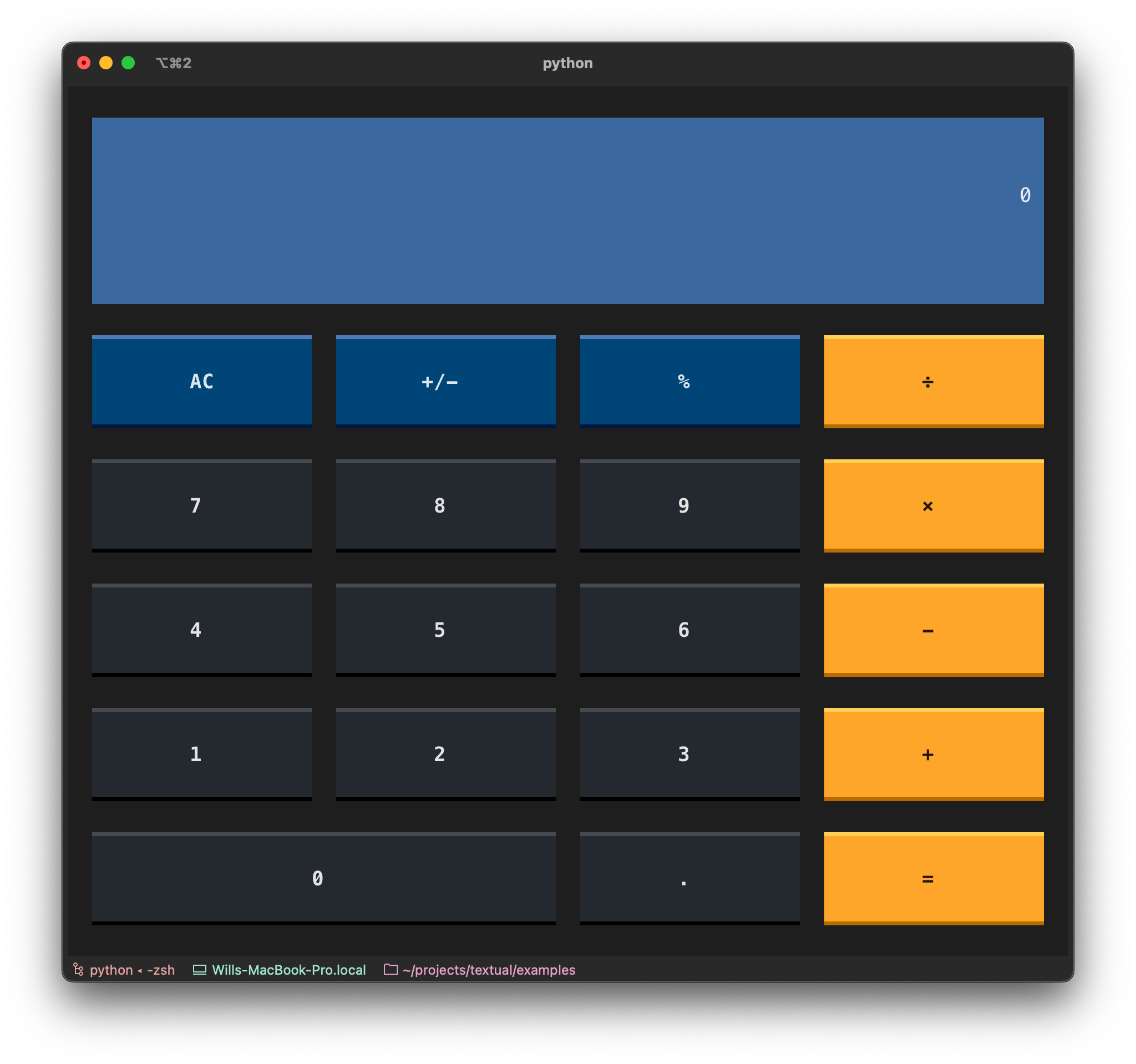
This is the Stopwatch example from the tutorial.
https://user-images.githubusercontent.com/554369/197360718-0c834ef5-6285-4d37-85cf-23eed4aa56c5.mov
Reference commands
The textual command has a few sub-commands to preview Textual styles.
🎬 Easing reference
This is the easing reference which demonstrates the easing parameter on animation, with both movement and opacity. You can run it with the following command:
textual easing
https://user-images.githubusercontent.com/554369/196157100-352852a6-2b09-4dc8-a888-55b53570aff9.mov
🎬 Borders reference
This is the borders reference which demonstrates some of the borders styles in Textual. You can run it with the following command:
textual borders
https://user-images.githubusercontent.com/554369/196158235-4b45fb78-053d-4fd5-b285-e09b4f1c67a8.mov
🎬 Colors reference
This is a reference for Textual's color design system.
textual colors
https://user-images.githubusercontent.com/554369/197357417-2d407aac-8969-44d3-8250-eea45df79d57.mov